About Our County
History of Cedar County
- Native American tribes including the Omaha, Ponca, and Sioux lived in the area for centuries prior to European settlement, with multiple prehistoric and historic village sites identified throughout the county.
- The Lewis and Clark Expedition traveled along the Missouri River near present‑day Cedar County in 1804 and held councils with the Sioux at Calumet Bluff, now near Gavins Point Dam.
- Cedar County was officially organized on February 12, 1857, by the Nebraska Territorial Legislature and named for the region’s plentiful cedar tree groves.
- The county’s boundaries were finalized in 1860, creating its current location along Nebraska’s northeastern border with South Dakota.
- Cedar County had three county seats during its early years:
- Old St. James (original location)
- St. Helena (1861–1885)
- Hartington, selected in 1885 due to its central location
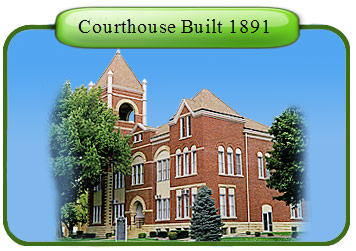
- The Cedar County Courthouse, built in 1891–1892, remains a defining landmark in Hartington and was constructed with locally produced brick in a Romanesque architectural style.
- Several Cedar County communities have historic ties to British nobility, including:
- Hartington, named for Lord Hartington
- Coleridge, named for Lord Coleridge
- Randolph, named for Lord Randolph Churchill
Cedar County Today – Community & Geography
- Cedar County is located in northeastern Nebraska and borders South Dakota along the Missouri River.
- The county encompasses approximately 746 square miles, featuring rolling prairie, fertile farmland, and river valley landscapes.
- Agriculture has long been the foundation of the local economy, with continued emphasis on farming and livestock production.
- Cedar County includes scenic natural resources and recreation areas such as:
- Lewis and Clark Lake
- Portions of the Missouri National Recreational River
- Multiple wildlife management and conservation areas
- Communities within Cedar County include Hartington, Laurel, Randolph, Wynot, Coleridge, Belden, Fordyce, Magnet, and St. Helena, each contributing to the county’s rural character and strong community identity.
- As of the 2020 U.S. Census, Cedar County had a population of 8,380 residents, with Hartington serving as the county seat and largest community.
Courthouse Addition
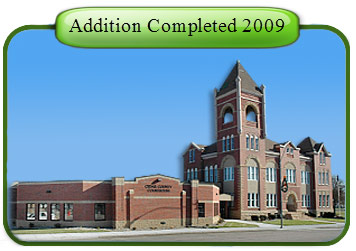
The Cedar County Courthouse was originally built back in 1891. The new courthouse (or an addition to the old courthouse depending how you look at it) was ready for staff to move in back in July, 2009. Below are images showing the before and after.
According to historians, three communities in Cedar County can claim a distant link to British royalty. As the story goes, Coleridge was named after Lord Coleridge, Randolph was named in honor of Lord Randolph Churchill, and the county seat of Hartington received its name as a tribute to Lord Hartington. All three Britons had visited the United States about the time the town sites were being established.
The history of this area in Northeast Nebraska can be traced back to the 1650s when the Omaha Indians lived along the Bow Creek area. For the next 90 years this area that borders the Missouri River on the north was home to the Omaha, Ponca and Sioux tribes. An occasional trapper or trader would pass through the area, but it was in 1804 with the exploration of Meriwether Lewis and William Clark that the area was first made known to the white man.
The Kansas-Nebraska Act of 1854 opened the territory to white settlers for the first time. Three years later Cedar County was organized by an act of the Territorial Legislature. The boundaries of the county, which was named as such because of the number of cedar trees that were growing in the area, were redefined in 1860 to their present dimensions.
Cedar County has had three county seats. The first was located in Old St. James, where a two-story frame courthouse was constructed. In 1858 the settlement of St. Helena, along the Missouri River, was established. Three years later, through an election, the county seat was moved to this settlement and would remain there until 1885. In the meantime, the townsite of Hartington was growing and in 1885 it was declared the county seat following an election. That same year bonds were approved for the construction of a courthouse. The decision to move the seat of local government to Hartington was made primarily because its central location was more accessible to the growing number of county residents.
Once covered by prairies grass, the county today is known for its farming and livestock production.